

In the industrial powder coating landscape, the powder coating booth stands as the cornerstone of any finishing operation, directly influencing coating quality, powder utilization, production efficiency, and workplace safety. Downdraft and crossdraft powder coating booths are the two most prevalent designs, each crafted with unique airflow engineering that tailors them to distinct production demands. As a 15-year professional manufacturer of powder coating solutions, a national high-tech enterprise, and the pioneer of China’s explosion-proof powder room system atGuanghe Coating Equipment, we’re breaking down the pivotal differences between these two booth types. This guide will help you select the ideal booth for your workshop, whether you operate a small custom fabrication shop or a high-volume automatic powder coating line for architectural aluminum or automotive components.
Leveraging insights from our partnerships with clients across 100+ countries and industry leaders like BYD, GREE, and Honda, we’ll explore airflow design, performance, ideal applications, cost factors, and compliance standards. By the end, you’ll have a clear roadmap to choose a booth that aligns with your finish quality goals, production volume, and budget.
1. Core Difference: Airflow Design – The Backbone of Booth Performance
The defining distinction between downdraft and crossdraft powder coating booths lies in airflow direction—a design choice that shapes every aspect of booth functionality, from overspray control to the uniformity of the powder finish. Both designs use filtered air to capture overspray, but the path of that air creates the fundamental performance gap between them.
a. Crossdraft Powder Coating Booths: Horizontal Airflow for Streamlined Operations
Crossdraft booths operate on a horizontal airflow principle: conditioned, filtered air is pushed into one side of the booth, travels horizontally across the workpiece, and carries powder overspray to a filtration or recovery system on the opposite side. This is the most straightforward booth design, with no complex ceiling or floor air distribution setups, making it a staple for basic powder coating workflows.
This horizontal airflow path gives crossdraft booths a compact physical footprint, requiring minimal vertical and horizontal space in your workshop—perfect for facilities with limited square footage. They’re also incredibly easy to install and modify, with far fewer components to maintain than downdraft models. For small-scale operations, this simplicity translates to lower upfront costs and faster setup times, getting your production up and running with minimal delay.
b. Downdraft Powder Coating Booths: Vertical Airflow for Precision Finishing
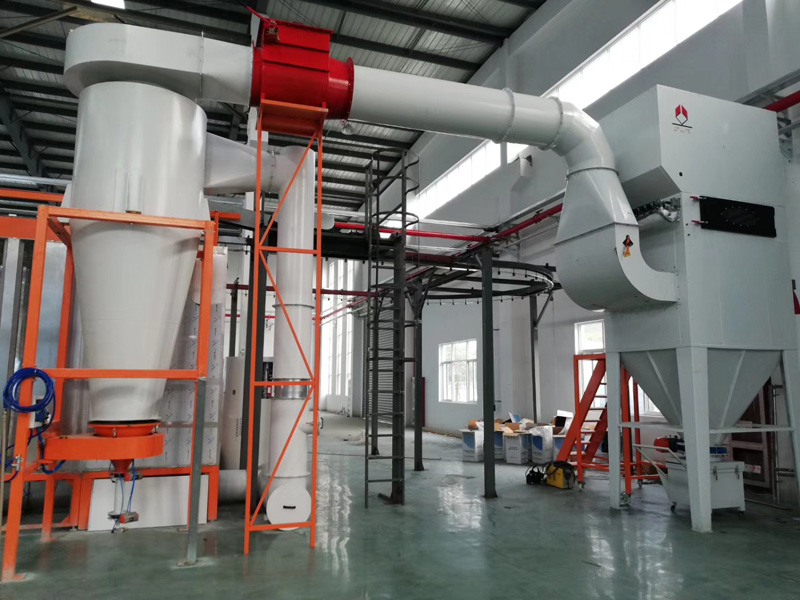
Downdraft powder coating booths utilize a top-to-bottom vertical airflow system: HEPA-filtered air is forced down from the booth’s ceiling plenum, fully enveloping the workpiece and carrying overspray directly into a floor-mounted filtration, cyclone, or powder recovery system. This short, direct airflow path eliminates the risk of overspray recirculating back onto freshly coated surfaces—a common pain point with crossdraft designs that leads to finish imperfections.
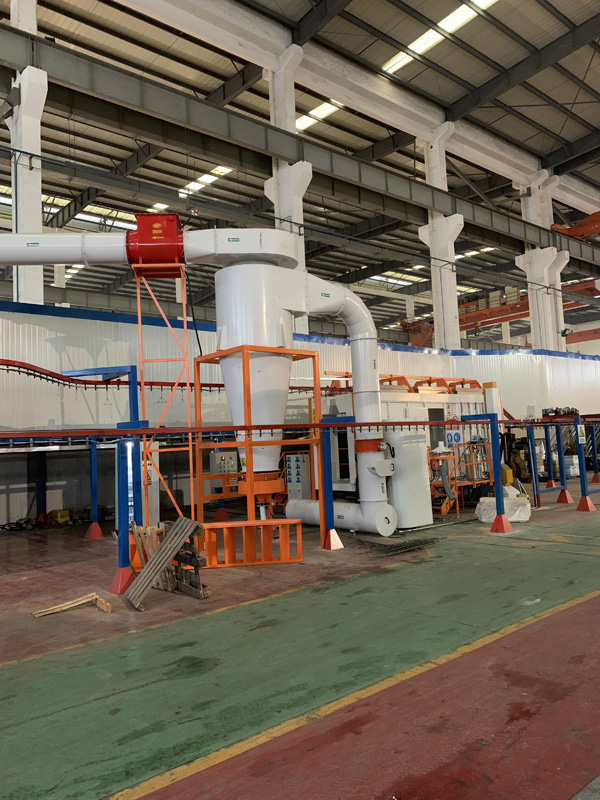
As a key component of our electrostatic powder coating line at Guanghe Coating Equipment, downdraft booths are engineered for uncompromising precision. The uniform vertical airflow ensures consistent powder deposition across the entire workpiece, even on complex shapes or extra-long architectural aluminum profiles (3–12m). Our explosion-proof downdraft booths—an industry first in China—also feature sealed airflow systems that meet stringent global safety standards, making them ideal for hazardous production environments.
2. Performance Comparison: Downdraft vs. Crossdraft – Which Delivers Better Results?
When evaluating downdraft and crossdraft booths, critical performance metrics like coating quality, powder recovery efficiency, overspray control, and color change flexibility directly impact your bottom line—from reducing material waste to cutting rework costs. Drawing on our decades of building industrial spraying equipment for global manufacturers, here’s a detailed look at how the two designs stack up in real-world production.
a. Coating Quality
Crossdraft booths deliver good results for basic, non-critical finishes, but their horizontal airflow creates a moderate risk of overspray and dust contamination settling on workpieces, leading to minor surface imperfections. This makes them suitable for products where finish precision isn’t a top priority. Downdraft booths, by contrast, produce superior, factory-perfect finishes with minimal contamination. The vertical airflow encapsulates the workpiece, preventing stray overspray or dust from marring the coating—making them the gold standard for high-precision applications like architectural aluminum, automotive parts, and aerospace components.
b. Powder Recovery Efficiency
Powder waste is a major cost driver in powder coating, and recovery efficiency is where downdraft booths pull far ahead. Crossdraft booths typically achieve an 80–85% recovery rate with basic bag or bucket filtration, meaning a significant portion of powder is lost to overspray. Downdraft booths, when paired with cyclone recovery systems and our high-performance Powder Coating Gun at Guanghe, hit a 95%+ recovery rate. This dramatic difference cuts material costs significantly and boosts sustainability, reducing your operation’s environmental footprint while improving profitability.
c. Overspray Control & Workplace Safety
Crossdraft booths offer moderate overspray control; their horizontal airflow can spread stray powder to surrounding workshop areas, leading to equipment contamination and a less clean work environment. Downdraft booths provide industry-leading overspray control— the vertical airflow contains overspray at the source, directing it straight to the floor-mounted recovery system. This keeps your workshop cleaner, reduces wear on other production equipment, and creates a safer working environment for your team. For hazardous production settings, our explosion-proof downdraft booths take safety a step further, meeting ISO9001 and CE certification standards for flammable or solvent-based powder applications.
3. Ideal Applications: Matching Booth Design to Your Production Needs
There is no one-size-fits-all powder coating booth; the right choice hinges on your production volume, finish quality requirements, workpiece size and type, and workshop space. Drawing on our experience serving clients in architectural aluminum, automotive, home appliances, and general hardware, we’ve outlined the perfect use cases for each booth design to help you make a targeted choice.
a. Crossdraft Powder Coating Booths: For Small-Scale, Basic Production
Crossdraft booths excel in low-to-medium volume operations where simplicity and cost-effectiveness are the top priorities. They’re the ideal choice for small workshops and custom fabrication shops—local metal shops, custom furniture makers, and small hardware manufacturers—with limited space and basic finish needs. They also work perfectly for single-color production, where frequent color changes aren’t a requirement, and for low-precision workpieces like general metal parts and non-architectural hardware, where minor surface imperfections are acceptable. For startups and budget-focused businesses, crossdraft booths minimize upfront investment and let you start production quickly, with our compact, customizable crossdraft models at Guanghe fitting even the tightest workshop layouts.
b. Downdraft Powder Coating Booths: For High-Volume, High-Precision Production
Downdraft booths are the industry standard for industrial powder coating operations that demand flawless finishes, maximum efficiency, and compliance with global safety standards. They’re essential for high-volume automated production lines, including our Aluminum Profile Automatic Powder Coating Spraying Machine setups, automotive parts manufacturing, and large-scale home appliance production for brands like Midea, Hisense, and GREE. They’re also the go-to for architectural aluminum and curtain wall components—3–12m long profiles and structural metal parts that need uniform, corrosion-resistant finishes for outdoor use.
Downdraft booths shine for multi-color production, where frequent powder color swaps are the norm, and our modular designs cut downtime for color changes to a minimum. For any workshop using solvent-based powders or flammable materials, our explosion-proof downdraft booths meet global explosion-proof standards, and they’re also the perfect choice for critical high-precision components like aerospace and medical parts, where zero coating contamination is non-negotiable. What’s more, our downdraft booths integrate seamlessly with our pretreatment system and Powder Coating Robot, creating a complete turnkey surface treatment solution for large-scale manufacturers.
4. Cost & Maintenance: Upfront Investment vs. Long-Term Savings
When choosing between downdraft and crossdraft booths, it’s essential to look past just the upfront cost and calculate the total cost of ownership (TCO)—including maintenance, material waste, energy use, and rework costs over 3–5 years. Upfront price tags only tell part of the story, and the long-term financial and operational benefits of each design vary drastically based on your production scale.
a. Upfront Investment & Installation
Crossdraft booths have a clear upfront cost advantage, coming in 20–30% less than a comparable downdraft booth. Their simple design means installation takes just 1–3 days, with no complex floor or ceiling modifications required—perfect for workshops that want to use existing infrastructure without major renovations. Downdraft booths have a higher initial investment, due to their complex airflow systems, floor-mounted recovery units, and for some models, concrete floor trenching for air ducts. Installation typically takes 5–7 days, but for high-volume producers, this upfront cost is quickly offset by massive long-term savings in material waste, energy, and rework.
b. Daily Maintenance & Operational Costs
Crossdraft booths have minimal maintenance requirements: their simple design means far fewer parts to inspect, and filters are easily accessible for quick swaps, cutting maintenance time and labor costs. Operational costs are moderate upfront, but the lower powder recovery rate leads to consistent material waste, and the risk of finish imperfections creates ongoing rework costs that add up over time. Downdraft booths require slightly more regular maintenance—such as cleaning ceiling air diffusers and servicing floor cyclone recovery systems—but our Guanghe downdraft models feature self-cleaning filters and modular components that minimize downtime and maintenance labor.
Operationally, downdraft booths are far more cost-effective in the long run: the 95%+ powder recovery rate eliminates most material waste, the uniform finish cuts rework to nearly zero, and our energy-efficient airflow designs reduce heating and ventilation costs. For high-volume production, these savings compound quickly, making downdraft booths a far more economical choice over the life of the equipment.
5. How to Choose the Right Booth: A Step-by-Step Guide from Guanghe
As a one-stop powder coating equipment provider with 15 years of experience and 40+ patent certificates, we’ve developed a simple, actionable step-by-step guide to help you select between downdraft and crossdraft booths—ensuring your choice aligns with your production goals and long-term business needs.
a. Assess your finish quality requirements
If you need flawless, consistent coatings for high-precision products like architectural aluminum or automotive parts, a downdraft booth is non-negotiable. For basic finishes with no strict precision standards, a crossdraft booth is sufficient.
b. Evaluate your production volume
High-volume, automated production demands the efficiency and powder recovery of a downdraft booth. Low-to-medium volume, manual production works perfectly with a crossdraft booth’s streamlined design.
c. Measure your workshop space
If your facility has limited vertical or horizontal space, a compact crossdraft booth is the practical choice. If you have the space for installation, a downdraft booth’s long-term benefits make it worth the footprint.
Final Thoughts
- Both downdraft and crossdraft powder coating booths are valuable for powder coating operations, with core differences in airflow design, performance priorities, and production fit.
- Crossdraft booths excel in simplicity and upfront cost savings, ideal for small-scale, basic production needs.
- Downdraft booths deliver superior precision, efficiency, and safety, tailored for high-volume, high-precision industrial coating.