In industrial surface treatment, spray painting lines and powder coating lines are the two core automated solutions for metal workpiece finishing—each with distinct coating principles, performance characteristics, and application scenarios. Choosing the wrong line leads to subpar coating quality, high operational costs, failed environmental compliance, and mismatched production needs. For manufacturers of architectural aluminum extrusions, industrial metal components, and automotive parts, understanding the key differences between the two lines is critical to selecting a solution that aligns with your workpiece specs, production capacity, and quality/regulatory goals.
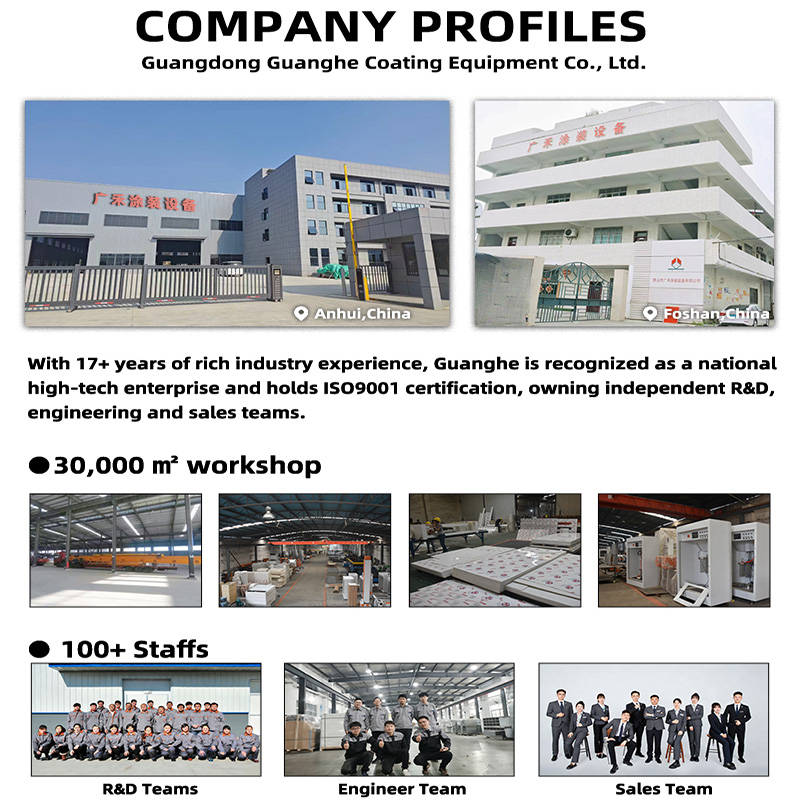
As a 15-year ISO9001/CE-certified manufacturer, pioneer of China’s explosion-proof powder room system, national high-tech enterprise with 40+ patents, and exporter to 100+ countries, Guangdong Guanghe Coating Equipment Co., Ltd. (Guanghe) designs and manufactures custom spray painting lines and powder coating lines for diverse industrial needs. Trusted by top brands including 广亚铝材,华建铝业,BYD, and GREE, our turnkey lines integrate modular core equipment—pretreatment systems, spray booths, automatic reciprocators, and curing ovens—engineered for seamless efficiency and compliance. Below, we break down the core differences between spray painting and powder coating lines across 5 critical dimensions, plus a practical selection guide and Guanghe’s tailored solutions to match your production needs.
Core Differences Between Spray Painting Line & Powder Coating Line
The two lines differ fundamentally in coating material, application process, and end performance—with clear tradeoffs in cost, environmental impact, and durability. We compare the key attributes side-by-side, with insights into real-world industrial application and Guanghe’s equipment optimizations for each line.
1. Coating Material & Application Process
Spray Painting Line
- Material: Liquid paint (water-based/solvent-based) with pigments, binders, and thinners (solvents or water for viscosity adjustment).
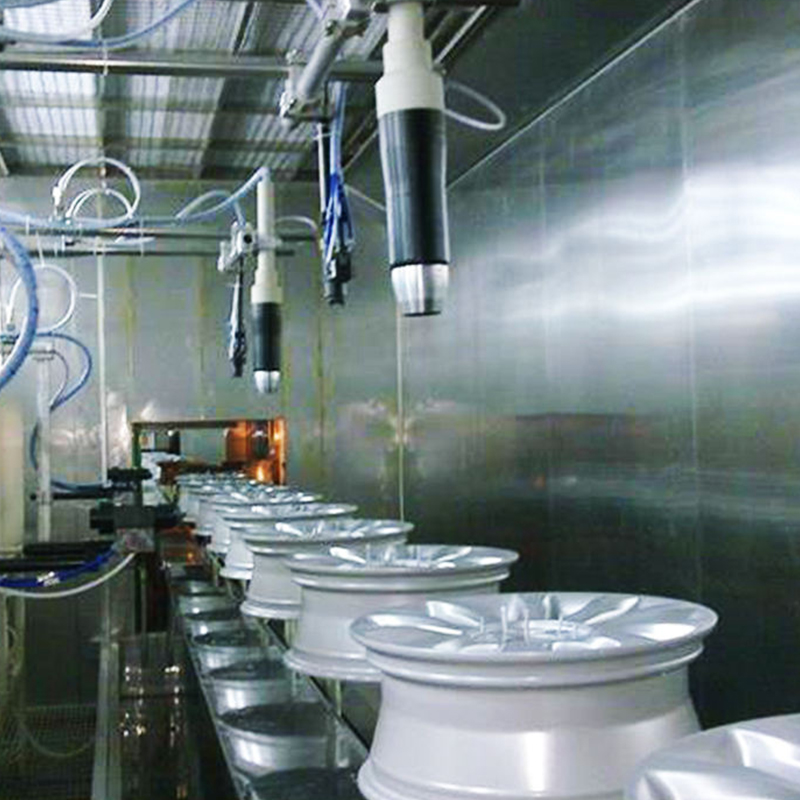
- Process: Liquid paint is atomized into fine droplets via high-pressure nozzles, sprayed onto workpieces, and cured via air-drying or low-temperature baking (60–80℃). The line features paint mixing, spraying, and drying zones, with waste paint collection for disposal.
- Guanghe’s Line Design: Compact paint circulation systems, high-efficiency atomizing spray guns, and low-temp energy-saving drying ovens—optimized for uniform paint deposition and minimal paint waste.
Powder Coating Line
- Material: Solid powder coating (100% solids, no solvents/thinners) made of resins, pigments, and additives.
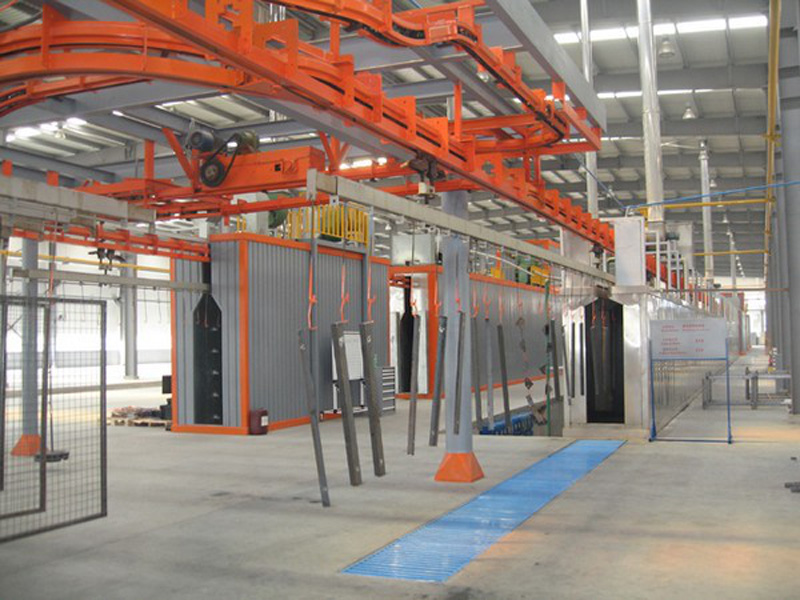
- Process: Powder is charged electrostatically, sprayed onto grounded metal workpieces (adhering via electrostatic attraction), and cured at high temperatures (180–220℃) in a dedicated oven—melting and forming a continuous, hard coating. The line includes a powder coating booth with 95%+ powder recycling (unsprayed powder is reclaimed for reuse).
- Guanghe’s Line Design: As the pioneer of China’s explosion-proof powder room system, our powder coating lines feature explosion-proof spraying zones, high-efficiency cyclone powder recovery, and servo-driven reciprocators for precise electrostatic deposition—our core specialty for architectural aluminum production.
2. Coating Performance & Durability
Spray Painting Line
- Key Performance: Smooth, high-gloss finish with excellent color matching (ideal for custom/multicolor finishes); thin, flexible coating (10–30μm thickness).
- Durability: Moderate resistance to scratch, corrosion, and UV damage (solvent-based paint performs better than water-based); prone to chipping, fading, and peeling in harsh outdoor/industrial environments.
- Limitations: Coating thickness is hard to control (risk of sagging); poor adhesion on unprimed metal without rigorous pretreatment.
Powder Coating Line
- Key Performance: Thick, uniform coating (60–120μm, the industry standard for architectural aluminum) with exceptional scratch, impact, and corrosion resistance; matte/semi-gloss finishes (custom high-gloss available).
- Durability: Superior long-term performance—UV-resistant, chemical-resistant, and fade-proof for outdoor/industrial use (ideal for architectural aluminum extrusions, industrial hardware, and automotive parts); no chipping or peeling with proper pretreatment.
- Advantage: One-coat coverage eliminates the need for priming/topcoating, reducing production steps.
3. Production Efficiency & Cost (Upfront + Operational)
Spray Painting Line
- Upfront Cost: Lower initial investment for basic lines (simpler curing and material handling); higher costs for water-based paint lines (needing advanced waste water treatment).
- Operational Cost: High ongoing costs—liquid paint has high material waste (30–50% unsprayed paint is non-recyclable), plus solvent/thinner refills; frequent nozzle cleaning and paint mixing add labor costs.
- Efficiency: Faster curing time (low-temp baking/air-drying) but slower spraying speed; ideal for small-batch, custom multicolor production.
Powder Coating Line
- Upfront Cost: Higher initial investment (high-temp curing ovens, electrostatic spray equipment, and powder recycling systems); lower costs for bulk production due to material efficiency.
- Operational Cost: Ultra-low ongoing costs—<5% material waste (recyclable powder), no solvent/thinner costs, and minimal maintenance; one-coat application cuts production time by 30% vs. spray painting.
- Efficiency: Slower high-temp curing but high-speed automated spraying; perfect for high-volume, standardized production (e.g., 6–12m architectural aluminum extrusions).
- Guanghe’s Edge: Our powder coating lines feature waste heat recovery curing ovens that cut energy costs by 25–30%, offsetting upfront investment for mid/high-volume manufacturers.
4. Environmental Compliance & Safety
Spray Painting Line
- Environmental Impact: Solvent-based paint releases VOCs (volatile organic compounds) that pollute air; water-based paint generates paint sludge/waste water that requires costly treatment to meet environmental standards (EPA/GB/EU).
- Safety: Low explosion risk (no dry powder dust) but solvent fumes require advanced ventilation systems; prolonged exposure to fumes is harmful to workers.
- Compliance: High costs to meet global VOC emission standards (a major barrier for export-oriented manufacturers).
Powder Coating Line
- Environmental Impact: 100% solvent-free (no VOC emissions); recyclable powder eliminates material waste, and no toxic waste water/sludge is generated—fully compliant with global environmental standards (EU EMC, CE, EPA).
- Safety: High dust explosion risk in the spraying zone (dry powder dust is flammable); this is the critical design challenge for powder coating lines.
- Guanghe’s Edge: As the pioneer of China’s explosion-proof powder room system, our powder coating lines feature ATEX/CE-certified explosion-proof design (sealed electrical components, dust-free air circulation, and anti-static booths)—eliminating ignition risks while meeting global safety standards.
5. Ideal Workpiece & Production Scenarios
Spray Painting Line
- Workpieces: Small-batch custom metal parts, decorative metalwork, automotive body parts, and workpieces requiring high-gloss/multicolor custom finishes; non-metal workpieces (plastic/wood, in addition to metal).
- Production Type: Small-batch, custom, or intermittent production; low-volume multicolor coating; workpieces sensitive to high-temperature curing (e.g., thin plastic-metal composites).
- Industries: Furniture, consumer electronics, custom automotive refinishing, and decorative metal fabrication.
Powder Coating Line
- Workpieces: High-volume standardized metal workpieces—6–12m architectural aluminum extrusions (curtain wall mullions, window frames), industrial metal hardware, automotive parts, and outdoor metal structures; only conductive metal workpieces (aluminum, steel, iron).
- Production Type: 24/7 continuous high-volume production; outdoor/industrial workpieces requiring high durability; explosion-proof workshop production.
- Industries: Architectural aluminum fabrication, industrial machinery, automotive component manufacturing, and construction hardware.
Practical Selection Guide: Spray Painting Line or Powder Coating Line?
Choose the right line based on 3 core factors—no single solution is better; the best choice aligns with your production and workpiece needs:
- Workpiece & Finish Requirements: Choose spray painting for custom high-gloss/multicolor finishes or non-metal workpieces; choose powder coating for metal workpieces needing superior durability/scratch resistance (e.g., architectural aluminum).
- Production Scale: Choose spray painting for small-batch/custom production; choose powder coating for mid/high-volume standardized production (the lower operational cost and material efficiency make it far more cost-effective).
- Environmental & Safety Standards: Choose powder coating for export-oriented production (100% VOC-free, meets global environmental standards); if explosion-proof design is not feasible (small workshops with limited space), water-based spray painting is a viable alternative (with proper waste water treatment).
- Curing Limitations: Choose spray painting for workpieces sensitive to high temperatures (≤80℃); powder coating requires high-temperature curing (180–220℃), ideal only for heat-resistant metal workpieces.
Guanghe’s Custom Spray Painting & Powder Coating Line Solutions
Guanghe’s core advantage is designing tailored, modular lines for both spray painting and powder coating—we do not offer one-size-fits-all equipment, and all our lines are engineered to match your factory space, production capacity, and compliance needs. Our key solutions include:
- Custom Powder Coating Lines [https://www.powdercoatequipment.com/]:Our flagship solution—explosion-proof design (our core specialty), modular layout (small/medium/large for ≤500t/500–2000t/≥2000t monthly output), and full integration of pretreatment systems, explosion-proof powder booths, servo-driven reciprocators, and energy-saving curing ovens. Optimized for 6–12m architectural aluminum extrusions, with 99.5% first-pass yield and 95%+ powder recycling.
- Custom Spray Painting Lines [https://www.powdercoatequipment.com/]:Water-based/solvent-based options, compact low-temp drying ovens, high-efficiency atomizing spray guns, and modular waste water/air treatment systems. Designed for small-batch custom production, with flexible color change capabilities and uniform finish for decorative metal/automotive parts.
- One-Stop Turnkey Support:All lines include free on-site factory layout planning, 24/7 technical support (+86 18520992137 / ghexport@coatmach.com), 12-month standard warranty (2-year extendable for bulk orders), and global spare parts stock (3–5 day urgent delivery). Guanghe also offers line upgrades (e.g., adding powder recycling to a basic spray line) for future production growth.
Conclusion
The core difference between a spray painting line and a powder coating line boils down to coating material and process—which dictates performance, cost, environmental impact, and application scenarios. Spray painting lines excel at custom, small-batch, high-gloss finishes (for metal/non-metal workpieces) with lower upfront costs but higher operational/environmental costs. Powder coating lines are the gold standard for high-volume, standardized metal workpieces (e.g., architectural aluminum) with superior durability, ultra-low material waste, and 100% VOC-free compliance—with the critical caveat of needing explosion-proof design for safety.
Guanghe’s 15 years of surface treatment expertise, 40+ patents, and explosion-proof engineering make us the trusted partner for manufacturers worldwide. Whether you need a custom spray painting line for small-batch custom production or a high-capacity explosion-proof powder coating line for architectural aluminum fabrication, our ISO9001/CE-certified lines are tailored to your exact needs—maximizing production efficiency, minimizing costs, and meeting global environmental/safety standards.
Ready to choose the right line for your production? Contact our engineering team for a free personalized consultation, or browse our full range of spray painting and powder coating line equipment on our official website—we turn your surface treatment goals into a streamlined, efficient reality.