For manufacturers of architectural aluminum extrusions, automotive components, metal hardware, and industrial parts, the pretreatment line is the backbone of a high-quality powder coating process—and the right size is non-negotiable. A pretreatment line that’s too small causes production bottlenecks, rushed processing, and poor coating adhesion; one that’s too large wastes floor space, energy, and operational costs.
As a 17-year national high-tech enterprise, China’s pioneer of explosion-proof powder coating systems, and a leading powder coating equipment manufacturer exporting to 100+ countries, Guangdong Guanghe Coating Equipment Co., Ltd. (Guanghe) designs custom pretreatment lines for factories of all scales—from small workshops to large-scale production hubs trusted by BYD, GREE, 广亚铝材,and Honda. This guide breaks down how to calculate the perfect pretreatment line size for your factory, aligning with your production volume, workpiece specs, and long-term growth goals—while integrating seamlessly with your powder coating line and powder coating booth.
1、Why Getting the Right Pretreatment Line Size Matters
Pretreatment (degreasing, rinsing, passivation, drying) removes contaminants from metal surfaces to ensure powder coating adhesion and long-term durability—and the process requires sufficient time and space for each stage. A mis-sized line creates cascading issues for your entire production workflow:
- Small Line Risks: Rushed processing leads to incomplete degreasing/passivation, causing coating peeling, chipping, and a 10%+ rework rate (the industry’s top productivity drain). Bottlenecks at pretreatment slow down your entire vertical powder coating line or horizontal coating system, reducing daily output by 30–50%.
- Large Line Risks: Excess capacity wastes valuable factory floor space (critical for small to mid-sized workshops) and increases energy costs—larger tanks and dryers use 20–40% more electricity and water, even at partial capacity. Overbuilt lines also add unnecessary upfront investment, with no ROI for unused space.
- Quality Consistency: The right size ensures uniform processing for every workpiece—whether 3–12m architectural aluminum profiles or small hardware—meeting AAMA 2604/2605, ISO 12944, and EU REACH compliance standards for export.
At Guanghe, every pretreatment line is engineered to match your exact production needs—no one-size-fits-all solutions, just precision design for maximum efficiency and quality.
2、Key Factors to Determine Your Pretreatment Line Size
Calculating the right pretreatment line size isn’t just about “factory square footage”—it’s a data-driven process based on 6 critical production and workpiece factors. These are the same metrics our engineers use to design custom aluminum profile pretreatment systems for global clients, and they apply to all metal coating applications (aluminum, steel, iron, brass).
a. Daily/Monthly Production Volume
Your production output is the foundation of pretreatment line sizing—how many parts you process per day dictates the line’s throughput capacity (measured in parts/hour or meters/hour for long profiles).
- Low Volume (≤500 parts/day / ≤1,000m of profiles): Small workshops, custom fabrication shops, or startups producing small hardware, custom metal parts, or short aluminum profiles (≤3m). A compact batch pretreatment line (manual or semi-automatic) is ideal, with small tanks and a compact dryer to fit floor space under 50㎡.
- Medium Volume (500–2,000 parts/day / 1,000–5,000m of profiles): Mid-sized factories producing architectural aluminum accessories, automotive parts, or medium-length profiles (3–8m). A semi-automatic continuous pretreatment line balances throughput and space, with modular tanks and a medium-capacity dryer for seamless integration with horizontal powder coating lines.
- High Volume (≥2,000 parts/day / ≥5,000m of profiles): Large-scale manufacturers producing 3–12m architectural aluminum extrusions, curtain wall components, or high-volume automotive parts for export. An automatic continuous pretreatment line (vertical or horizontal) is required, with large-capacity tanks, high-speed conveyors, and industrial dryers—engineered to sync with vertical powder coating lines for long profile processing.
Guanghe Tip: Always size for 10–20% future growth—our modular pretreatment lines let you add tanks or extend conveyors as your production volume increases, avoiding costly full replacements.
b. Workpiece Dimensions (Length, Width, Height)
The size of your parts—especially long architectural aluminum profiles—dictates the pretreatment line’s conveyor length, tank size, and dryer dimensions. This is the most critical factor for manufacturers of 3–12m aluminum extrusions, the core focus of Guanghe’s pretreatment line design.
- Long Workpieces (3–12m Aluminum Profiles/Facade Components): Require a vertical pretreatment line (Guanghe’s specialty) with tall tanks and vertical conveyors to avoid bending or scratching long profiles—horizontal lines for this size waste floor space (a 12m horizontal line needs 15+ meters of factory length). Our vertical pretreatment lines handle 3–12m profiles with precision, with adjustable conveyor speeds (0.3–6m/min) for optimal processing time.
- Medium Workpieces (1–3m Parts/Hardware/Automotive Components): A horizontal pretreatment line is ideal, with standard-sized tanks and conveyors that fit most factory layouts. Guanghe’s horizontal lines are modular, so you can adjust tank length/width for irregularly shaped parts (e.g., large industrial machinery components).
- Small Workpieces (≤1m Hardware/Electronic Parts): A batch pretreatment line with small tanks or basket processing is efficient, saving space and reducing water/energy use. For high-volume small parts, we offer compact continuous lines with narrow conveyors for automated processing.
c. Workpiece Material and Coating Requirements
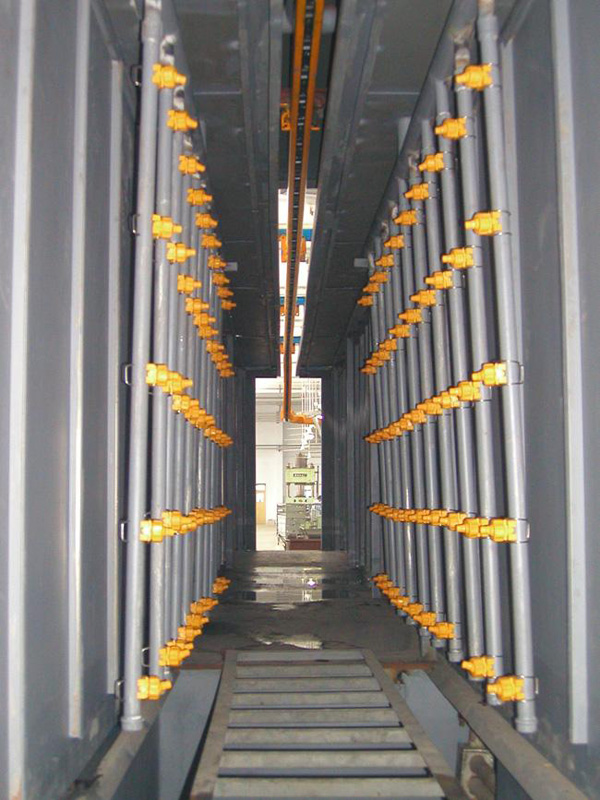
Different metal materials and coating standards require different pretreatment stages—more stages mean a longer line (e.g., aluminum needs chromate-free passivation for export compliance, while steel needs phosphating for corrosion resistance). The number of stages directly impacts line size and layout:
- Basic Pretreatment (3–4 stages: Degreasing → Rinsing → Drying): For low-demand steel parts or internal-use metal hardware—ideal for small compact lines, minimal floor space.
- Standard Pretreatment (5–6 stages: Degreasing → Rinse → Pickling → Rinse → Passivation → Drying): For architectural aluminum profiles (6063/6061) and automotive parts—meets AAMA 2604 standards, the most common setup for Guanghe’s mid-sized lines.
- Premium Pretreatment (7+ stages: Degreasing → Rinse → Pickling → Rinse → Passivation → Sealant → Rinse → Drying): For high-end export parts (AAMA 2605, ISO 12944 C5), marine components, or heavy-duty industrial machinery—requires a longer line with additional tanks, engineered for maximum corrosion resistance.
d. Factory Floor Space and Layout
Your available floor space (length, width, ceiling height) and existing factory layout—including access for conveyors, water/electricity connections, and integration with existing powder coating equipment—dictate whether a vertical, horizontal, or compact pretreatment line is feasible.
- Limited Floor Space (≤100㎡): Vertical pretreatment lines (for long profiles) or compact batch horizontal lines (for small/medium parts) are the only options—Guanghe’s vertical lines use 60% less floor space than horizontal lines for 3–12m profiles.
- Ample Floor Space (≥200㎡): Full-length horizontal continuous pretreatment lines or custom integrated lines (pretreatment + powder coating + curing) are possible, with room for additional stages (e.g., sealant) and high-speed conveyors.
- Ceiling Height Consideration: Vertical pretreatment lines require a ceiling height of 4–12m (matching profile length)—Guanghe’s engineers conduct on-site factory measurements to ensure perfect fit, a core part of our custom equipment solutions.
e. Automation Level (Manual/Semi-Automatic/Automatic)
The automation level of your pretreatment line impacts its size, cost, and labor requirements—automated lines have larger conveyors and control systems but reduce manual labor, while manual lines are compact and low-cost for small factories.
- Manual: Small batch lines with hand-operated tanks/conveyors—≤50㎡ floor space, ideal for startups with limited capital.
- Semi-Automatic: Modular horizontal lines with automated conveyors and manual tank refilling—50–150㎡ floor space, perfect for growing mid-sized factories.
- Automatic: Full vertical/horizontal lines with PLC-controlled conveyors, automatic chemical dosing, and integrated drying—150+㎡ floor space, for large-scale export manufacturers (Guanghe’s automatic lines use Mitsubishi/Siemens core parts for reliable 24/7 operation).
f. Integration with Existing Powder Coating Equipment
Your pretreatment line must work seamlessly with your existing powder coating gun, powder coating booth, curing oven, and conveyor system—misalignment causes production delays and poor part transfer. At Guanghe, all our pretreatment lines are pre-tested to integrate with our full range of powder coating equipment, as well as third-party systems:
- Vertical pretreatment lines sync with vertical powder coating lines for 3–12m aluminum profiles, with matching conveyor speeds to avoid bottlenecks.
- Horizontal pretreatment lines integrate with crossdraft/downdraft powder coating booths and horizontal coating lines, with smooth part transfer to minimize scratching.
- All lines include compatible drying stages to ensure parts are 100% dry before coating—eliminating moisture bubbles (a top cause of coating defects).
3、How to Calculate Your Exact Pretreatment Line Size (A Simple Formula)
Using the 6 factors above, you can calculate a baseline pretreatment line size—Guanghe’s engineers use a more detailed version of this formula for custom designs, but it’s perfect for factory owners to estimate their needs:
Pretreatment Line Length (m) = (Number of Stages × Tank Length) + Conveyor In/Out Zones + Dryer Length
- Tank Length: Matches your longest workpiece (e.g., 12m profile = 12m tank for vertical lines; 3m part = 3m tank for horizontal lines).
- Number of Stages: 3–4 (basic) → 5–6 (standard) → 7+ (premium).
- Conveyor In/Out Zones: 1–2m each (for loading/unloading parts).
- Dryer Length: 2–8m (based on production volume—longer dryers for high-speed conveyors).
Example: A standard 6-stage pretreatment line for 6m aluminum profiles = (6 × 6) + 1 + 1 + 4 = 42m horizontal line (or a 6m vertical line that uses just 10㎡ of floor space—Guanghe’s vertical design advantage).
For a precise calculation, Guanghe offers free factory on-site measurements and 3-day custom design services—our engineers assess your production, workpieces, and layout to create a pretreatment line that’s perfectly sized for your needs.
4、Guanghe’s Pretreatment Line Sizing Options (For Every Factory)
As a one-stop powder coating equipment supplier, Guanghe offers 3 core pretreatment line sizes—all customizable—engineered for different factory scales, workpiece types, and production goals. Every line is ISO9001/CE certified, with energy-saving design, explosion-proof options for hazardous environments, and global after-sales support.
a. Compact Batch Pretreatment Line (Small Factories/Startups)
- Ideal For: Low volume (≤500 parts/day), small workpieces (≤3m), limited floor space (≤50㎡), manual/semi-automatic operation.
- Key Specs: 3–4 processing stages, small tanks (1–3m), compact dryer, manual conveyor/basket processing.
- Guanghe Advantages: Low upfront investment, quick installation (1–2 weeks), energy-efficient design (cuts water/electricity use by 20%), and easy upgrade to semi-automatic as production grows.
b. Semi-Automatic Horizontal Pretreatment Line (Mid-Sized Factories)
- Ideal For: Medium volume (500–2,000 parts/day), medium workpieces (1–8m), 50–150㎡ floor space, semi-automatic operation.
- Key Specs: 5–6 processing stages, modular tanks (3–8m), medium-capacity dryer, PLC-controlled conveyors, automatic chemical dosing (optional).
- Guanghe Advantages: Balances throughput and space, integrates with horizontal powder coating lines, 95% processing consistency, and modular design for stage add-ons (e.g., sealant for export parts).